
Published:
Understanding Mutual Funds Pricing Mechanism
When investors think about mutual funds, they focus on performance, returns, and risk.
Yet one of the most essential but often overlooked aspects of investing in mutual funds is understanding how they are priced and how the pricing mechanism works.
Unlike stocks where investors buy and sell at real-time market prices mutual funds follow a structured pricing mechanism.
This mechanism determines:
When your investment gets processed
Which price you receive
How many units you are allocated
When your redemption gets executed
Understanding mutual fund pricing mechanism is crucial because the price you receive has a direct impact on your returns. Since mutual funds calculate their price once daily, understanding the mechanics behind it becomes necessary.
The price calculated is known as Net Asset Value (NAV) and the mechanism through which it is calculated is known as pricing mechanism.
This article explains mutual fund pricing mechanism in detail, covering:
What pricing mechanism is
Why mutual funds have a use for pricing mechanisms
What cut-off time means
Forward pricing mechanism
Backward pricing mechanism
Which funds rely on which mechanism
How pricing has an impact on your returns
Practical examples
Best practices for investors
By the end of this article, you will have a complete understanding of how mutual funds set your investment price.
What is Mutual Fund Pricing Mechanism?
A pricing mechanism is the rule mutual funds use to determine which Net Asset Value (NAV) applies when investors:
Invest in a fund
Redeem units
Switch between funds
Mutual funds do not trade like stocks. Instead mutual fund units are created or cancelled when investors subscribe or redeem.
Because mutual funds calculate their NAV once , there must be a structured process to determine:
Which day's NAV applies
When transactions are processed
How fairness is ensured among investors
This structured process is known as a pricing mechanism.
Why Do Mutual Funds Use Pricing Mechanism?
Mutual funds use pricing mechanisms for several key reasons.
Ensuring Fairness Among Investors
Pricing mechanisms ensure fairness among investors who enter and exit the fund.
Without pricing rules:
Investors could exploit market movements
Late investors could gain unfair advantage
Existing investors could face dilution
For example, if an investor knew the NAV before investing, they could invest after markets rise and benefit .
Pricing mechanism ensures:
Equal treatment for all investors
Fair unit allocation
Transparent pricing
This protects both new and existing investors.
Preventing Market Timing Abuse
Market timing occurs when investors attempt to take advantage of short-term price movements.
For example:
Investor sees market rising
Investor invests before NAV calculation
Investor benefits from known price movement
This creates unfair advantage.
Forward pricing prevents this behavior by ensuring:
Investors do not know NAV beforehand
No one can exploit known market movements
This is especially important in volatile funds.
Regulatory Requirements
Regulators such as SECP (Securities and Exchange Commission of Pakistan) require mutual funds to follow specific pricing rules.
These rules ensure:
Investor protection
Market transparency
Standardized practices
Regulations allow:
Forward pricing for volatile funds
Backward pricing for stable funds
This ensures pricing aligns with risk level.
Understanding NAV and Its Role in Pricing
Before understanding pricing mechanisms, you need to understand Net Asset Value (NAV).
NAV is the price per unit of a mutual fund. When you invest in a mutual fund, you do not buy stocks or bonds . Instead, you buy units of the mutual fund.
A unit represents your share or ownership in the mutual fund.
To make this easier to understand, let's look at a simple example.
Example for understanding units
Imagine a group of 10 investors come together to create a mutual fund.
Each investor contributes PKR 10,000.
Total money collected: 10 investors × 10,000 = PKR 100,000
Now, the fund decides to divide ownership into 10,000 units.
So each unit is worth: 100,000 ÷ 10,000 = PKR 10 per unit
This means:
NAV = PKR 10
Total Units = 10,000
Each investor receives units based on their investment
If you invest PKR 10,000, you receive: 10,000 ÷ 10 = 1,000 units
So now:
You own 1,000 units
Each unit = PKR 10
Your total investment value = 10,000
The calculation works as:
NAV = (Total Assets − Total Liabilities) ÷ Total Units Outstanding
Now, in case of mutual funds. Total assets include:
Stocks
Bonds
Cash
Government papers
Sukuks etc.
Liabilities include:
Management fees
Trustee fees
Regulatory charges
Why NAV Changes Daily
NAV changes because underlying investments change in value. Think of it like having a basket of goods whose price changes .
NAV calculates the price of that basket every day. Now, replace the basket with stocks, bonds, government papers etc.
Here's an example:
Stock prices fluctuate
Bond prices change
Interest income accrues
Different funds experience different NAV volatility:
Fund type | NAV Movement |
|---|---|
Equity Funds | High |
Income Funds | Medium |
Money Market Funds | Low |
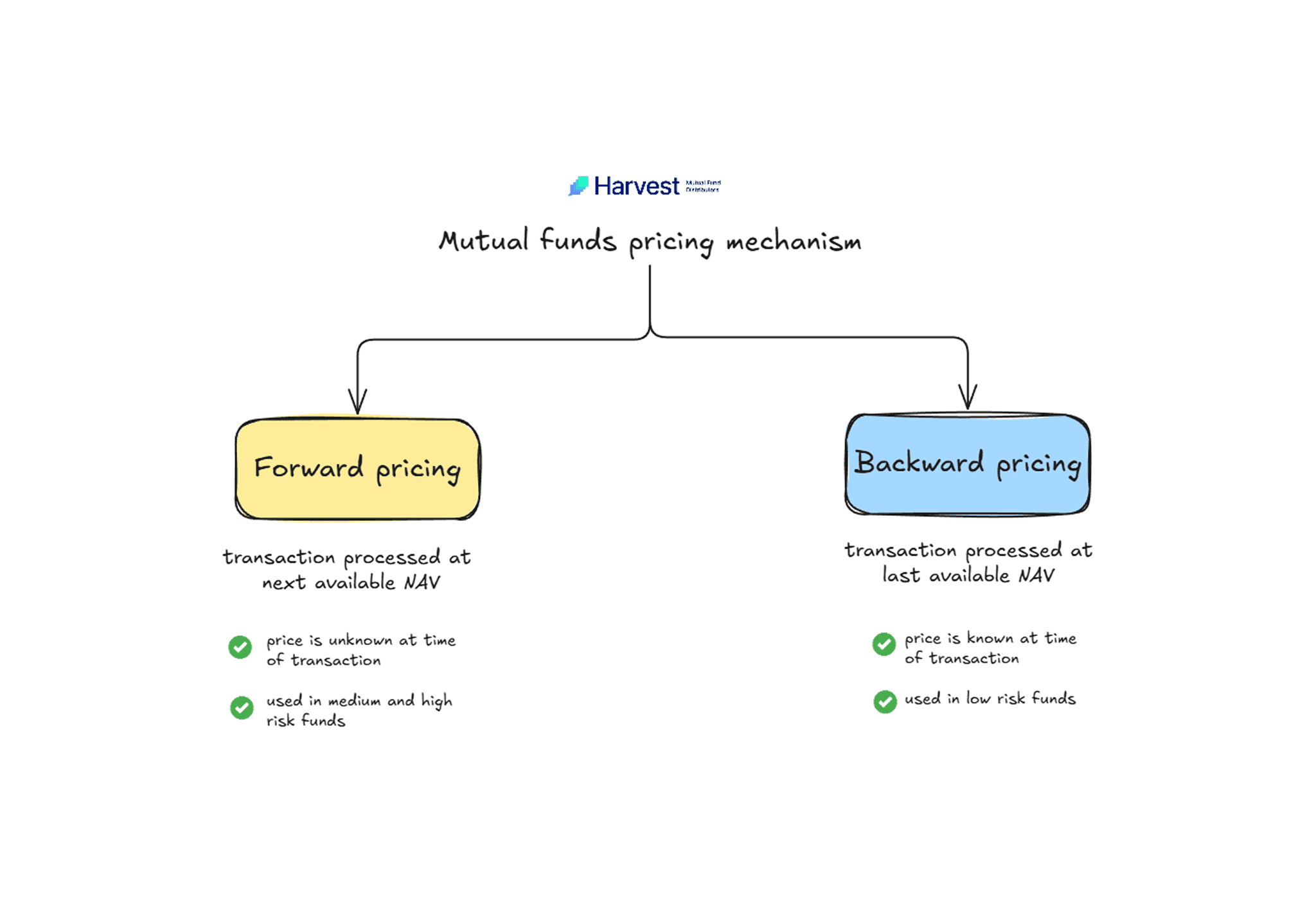
Two Types of Pricing Mechanism
Mutual funds use two distinct methods to apply NAV when they process investor transactions.
The pricing mechanism determines whether you transact at a price already known or one that will be calculated after you submit your order.
Forward Pricing Mechanism
What is Forward Pricing?
Forward pricing means you invest first and receive the next available NAV.
At the time of investment:
NAV is unknown
Price determined later
Forward pricing executes your transaction at the next available NAV, which hasn't been calculated when you place your order.
Why Forward Pricing is Used
Forward pricing is used to:
Stop market timing
Protect investors
Make sure things are fair
Stop arbitrage
This matters for volatile funds.
Backward Pricing Mechanism
What is Backward Pricing?
Backward pricing lets investors invest using the last available NAV.
At the time of investment:
NAV is known
Price already set
Backward pricing, on the other hand, executes your transaction at the most calculated NAV, a price already set before you submit your order.
When you invest, you can look up the applicable NAV and calculate how many units you will receive.
The price was set earlier that morning or on the previous business day. This transparency resembles putting money in a bank account where the interest rate is known upfront.
Why Backward Pricing is Used
Backward pricing is used when:
NAV volatility is low
Risk is minimal
Price movement predictable
This allows:
Immediate decision making
Treasury convenience
Predictable pricing
Forward vs Backward Pricing
Feature | Forward pricing | Backward pricing |
|---|---|---|
NAV Known | No | Yes |
Risk level | Medium / High | Low |
Investor certainity | Low | High |
What is Cut-Off Time?
Every mutual fund sets a daily deadline that decides which net asset value applies to your transaction. This cut-off time acts as the line between orders processed at the current day's NAV and those rolled to the next business day.
What Cut-Off Time Decides
The cut-off time is the specific hour each business day after which your order no longer qualifies for that day's NAV calculation.
Orders received before this deadline get processed using the current day's NAV, while orders arriving after the cut-off are rolled forward to the next business day's NAV.
This rule applies to both purchase and redemption requests ensuring fair treatment across all investors regardless of transaction size.
Investing Before the Cut-Off
Investing in forward priced funds
For forward pricing funds submitting your order before the cut-off means you receive the same day's NAV even though that price remains unknown when you invest.
For instance, if you invest at 2:30 PM and the cut-off is 3:00 PM, you receive that day's NAV announced at 6:00 PM.
If yesterday's NAV was 100 and today's NAV calculates to 105, you get NAV 105 despite the price being unknown at 2:30 PM.
Investing in backward priced funds
With backward pricing funds investing before the cut-off locks in the known NAV published that morning.
If you invest at 2:00 PM with a 4:00 PM cut-off and the NAV is 100, you receive 100 per unit. Even if the NAV changes later, you still get 100 because backward pricing uses prices that are already determined.
Investing After the Cut-Off
Missing the cut-off deadline pushes your transaction to the next business day regardless of the pricing mechanism.
In forward pricing, an investment at 3:30 PM after a 3:00 PM cut-off gets processed at tomorrow's NAV. If today's NAV is 105 and tomorrow's calculates to 108, you receive NAV 108.
In the same way backward pricing funds process after-hours orders on the following day. An investment made at 4:30 PM after a 4:00 PM cut-off gets the next day's NAV of 101 instead of today's 100.
Typical Cut-Off Times in Pakistan
Cut-off times vary by fund type, with more volatile funds having earlier deadlines:
Fund Type | Cut-off Time |
|---|---|
Equity Funds | 3:00 PM |
Income Funds | 3:00 PM |
Money Market Funds | 4:00 PM |
Please note that these times vary by asset management company, so verify the specific cut-off with your fund house before placing orders.
Which fund use which pricing mechanism?
Fund type | Pricing mechanism |
|---|---|
Equity funds | Forward pricing |
Income funds | Forward pricing |
Asset allocation funds | Forward pricing |
Balanced funds | Forward pricing |
Index tracker funds | Forward pricing |
Fund of funds | Forward pricing |
Money market funds | Backward pricing |
Cash funds | Backward pricing |
Why Equity Funds Need Forward Pricing
Equity funds require forward pricing because of their volatile nature. Share prices fluctuate minute-to-minute during trading hours creating substantial NAV uncertainty. If investors knew the NAV before investing, they could exploit market-moving events that occurred after hours, a practice called late trading abuse. Forward pricing eliminates this risk by ensuring no investor can time their trade based on known price information. In the same way, income funds use forward pricing because bond prices change with interest rate movements creating opportunities for arbitrage if prices were known in advance.
Why Money Market Funds Use Backward Pricing
Money Market funds invest in short-duration liquid instruments like Treasury Bills short-term bank placements and government-backed securities. These instruments maintain very stable predictable prices because they are held to maturity with daily interest accrual. The NAV of a Money Market fund changes by a tiny predictable amount each day often fractions of a paisa per unit, which makes price arbitrage impossible. Because of this backward pricing supports same-day or next-day settlement because the transaction price requires no waiting for market close. This proves ideal for corporate treasury and institutional investors who need immediate certain pricing to manage short-term liquidity needs.
How Pricing Mechanism Impacts Returns
How NAV Pricing Affects Your Investment Returns
Your position relative to the cut-off time creates measurable differences in your mutual fund returns when markets move within a single day.
Same Day NAV vs Next Day NAV
Orders submitted before the cut-off receive the current day's NAV, while orders after the deadline roll to the next business day's NAV.
This one-day difference determines which day's market movements have an impact on your transaction price.
When you invest before the cut-off in forward pricing funds, you receive the NAV calculated after market close on your order date. Missing the cut-off means waiting to calculate the following day's NAV.
Impact in Rising Markets
When markets climb investing before the cut-off captures that day's higher NAV. You receive fewer units because the price per unit has increased, but your investment reflects current market value.
If yesterday's NAV was 100 and today's calculates to 105, a PKR 100,000 investment before the cut-off yields 952.38 units at the higher price. Missing the cut-off could mean facing an even higher NAV tomorrow if the upward trend continues.
Impact in Falling Markets
Declining markets reverse this dynamic. Investing before the cut-off locks in a lower NAV than yesterday's level giving you more units per rupee invested.
However, if you expect more drops, a wait until after the cut-off to catch the next day's lower NAV might work in your favor.
Money Market vs Equity Fund Differences
The scale of this effect changes depending on fund type. Money Market funds display minimal gaps between same-day and next-day NAV just a few paisa per unit that reflects one day of interest growth.
Equity funds, by contrast, can see 1-2% daily NAV movements, which means hundreds or thousands of rupees in difference on large investments.
To wrap up
Understanding NAV mechanics empowers you to make better-informed investment decisions. This knowledge clarifies why your mutual fund price changes and how timing affects your actual transaction price.
The distinction between forward and backward pricing has a direct impact on your investment experience when markets move . Cut-off times act as essential deadlines that determine whether you capture today's or tomorrow's NAV.
Your returns depend not just on selecting the right fund but also on understanding when your order gets executed and at what price. Master these pricing fundamentals, and you'll approach mutual fund investing with greater confidence and strategic awareness of how daily valuation works.